Tuesday, December 8, 2015
Module 8
I don't know what it is, but I find music that address social/political issues to be completely fascinating. After reading the blurb in the text about "Bodysnatchers" by Radiohead I found a lyric video on YouTube. It's interesting to listen to the song and follow along with the lyrics while thinking about what Radiohead is actually talking about. I would definitely have to agree with them that the music industry has become very corporate. It seems that if you are going to make music with one of these corporations you have to look, sound, and act a certain way. That's not the way the music industry should be run; it's not how it started. This was a good song - nice vocals, up-beat rock feel, powerful lyrics.

Sunday, December 6, 2015
Module 7
This week's listening was a mixed bag. The first three songs I listened to ("Sweet Dreams," "Jump," and "Sledgehammer") all had one major thing in common - electronic sounds, usually a synthesizer. I honestly didn't know that the singer in "Sweet Dreams" was Annie Lennox. For the majority of the listening experience I thought I was hearing a man. Perhaps I'm just wrong, but when I think of Van Halen I usually think of rock music. I would not consider "Jump" to be a rock song. It's definitely pop-rock, a new genre that probably originated in the 80s. It was very upbeat and made the listener want to get up and move - it would probably work well on a workout playlist. I couldn't tell if "Sledgehammer" began with humming or instruments. Again, another pop-rock style. This song, however, seemed to be using tools as codes for sex.
I'm not a fan of Prince. I respect him as a musician and believe he is very talented, but I don't like his sex anthems of the 80s. I had to find a video for "When Doves Cry" because it seemed almost impossible to find on a streaming music service. I regret watching that video. If the lyrics were bad, add a video with Prince basically dry-humping some girl. It definitely wasn't something I'd voluntarily watch or listen to.
Since I pretty much know nothing about hip-hop and am choosing to write my final paper on the history and evolution on hip-hop, I used most of my elective listening options on the hip-hop selections. The first one, "Walk This Way" as a duet by Run DMC and Aerosmith is great! I actually found a documentary online where one of the members of Run DMC said that they were told to sit down and learn the original lyrics. By doing that, I think Run DMC and Aerosmith were able to respect and work with each other better and produced a great crossover hit. This was a great example of what hip-hop music was, fun and upbeat. Then Public Enemy came around and changed things. They were there to use hip-hop to really shed light on social issues and injustices that the world just simply ignored. I really liked "Night of the Living Baseheads." The fact that the lyrics were clear and easy to understand was great - usually hip-hop/rap that is more recent is very hard to understand. I like the lyrics really meant something - discussing the drug problem in inner cities. This type of hip-hop reminds me of early folk music, like the music of The Almanacs, where they are singing about something that needs to change. Sadly, I followed this with "What's My Name?" I'm definitely not a fan of gangsta rap. The lyrics were unintelligent (sorry, but who really cares about how great Snoop Dog is?) and there really just wasn't anything special about it.
I'm not sure how I feel about Nirvana. I've heard "Smells Like Teen Spirit" many times, but I never really listened to the lyrics. So I sat down and followed the lyrics with the song. It was pretty pointless since I had no idea what he was talking about. I really like the fact that we've brought back the real instruments and started this new sub-genre -alternative rock. After doing some digging online, it seems that the lyrics are supposed to represent the revolt of teenagers. I think there are much better Nirvana songs. I like this performance of "Where Did You Sleep Last Night" because it's acoustic, but if you watch the beginning you can see how real Kurt Cobain is. He honestly gives no craps about anyone!
"Doo Wop" was great. Lauryn Hill really just says it like it is. She starts by talking about how if a girl is going to give it away easily one time, she'll probably do it again just as easily. The same goes for the men, except she starts talking about how men need to step up (she specifically mentions child support). Continuing on the powerful women, "Nowhere to Stand" is a song that I'd never heard. It sounded very folky to me with the acoustic instruments and the meaning behind the song. I could be wrong, but I interpreted the song as being about child abuse.
Timeline Link
I'm not a fan of Prince. I respect him as a musician and believe he is very talented, but I don't like his sex anthems of the 80s. I had to find a video for "When Doves Cry" because it seemed almost impossible to find on a streaming music service. I regret watching that video. If the lyrics were bad, add a video with Prince basically dry-humping some girl. It definitely wasn't something I'd voluntarily watch or listen to.
Since I pretty much know nothing about hip-hop and am choosing to write my final paper on the history and evolution on hip-hop, I used most of my elective listening options on the hip-hop selections. The first one, "Walk This Way" as a duet by Run DMC and Aerosmith is great! I actually found a documentary online where one of the members of Run DMC said that they were told to sit down and learn the original lyrics. By doing that, I think Run DMC and Aerosmith were able to respect and work with each other better and produced a great crossover hit. This was a great example of what hip-hop music was, fun and upbeat. Then Public Enemy came around and changed things. They were there to use hip-hop to really shed light on social issues and injustices that the world just simply ignored. I really liked "Night of the Living Baseheads." The fact that the lyrics were clear and easy to understand was great - usually hip-hop/rap that is more recent is very hard to understand. I like the lyrics really meant something - discussing the drug problem in inner cities. This type of hip-hop reminds me of early folk music, like the music of The Almanacs, where they are singing about something that needs to change. Sadly, I followed this with "What's My Name?" I'm definitely not a fan of gangsta rap. The lyrics were unintelligent (sorry, but who really cares about how great Snoop Dog is?) and there really just wasn't anything special about it.
I'm not sure how I feel about Nirvana. I've heard "Smells Like Teen Spirit" many times, but I never really listened to the lyrics. So I sat down and followed the lyrics with the song. It was pretty pointless since I had no idea what he was talking about. I really like the fact that we've brought back the real instruments and started this new sub-genre -alternative rock. After doing some digging online, it seems that the lyrics are supposed to represent the revolt of teenagers. I think there are much better Nirvana songs. I like this performance of "Where Did You Sleep Last Night" because it's acoustic, but if you watch the beginning you can see how real Kurt Cobain is. He honestly gives no craps about anyone!
"Doo Wop" was great. Lauryn Hill really just says it like it is. She starts by talking about how if a girl is going to give it away easily one time, she'll probably do it again just as easily. The same goes for the men, except she starts talking about how men need to step up (she specifically mentions child support). Continuing on the powerful women, "Nowhere to Stand" is a song that I'd never heard. It sounded very folky to me with the acoustic instruments and the meaning behind the song. I could be wrong, but I interpreted the song as being about child abuse.
Timeline Link
Sunday, November 29, 2015
Module 6
This week's listening involves music of the 1970s and "different" music. I don't listen to a lot of music from the 70s, so it was interesting to hear how diverse music was becoming at that time. It seemed like in just the previous chapter, music all followed the same stylistic patterns, but now we're starting to get some differentiation.
I started this week with something familiar, "Superstition" by Stevie Wonder. I think Stevie Wonder is a genius. He really explored using different instruments and playing them in a new way. It was interesting to read that Wonder played most of the instruments himself and just overdubbed himself in the studio. I love "Superstition" because of the up-beat tempo and funky sounds. Completely different was Elton John's "Crocodile Rock." When I think of Elton John, this isn't what I usually think of. The synthesizer and piano introduction was interesting. When the "la-la's" came in, I felt like I was taken back to early rock sounds. Even more different was "Love's Theme" by Barry White. Barry White has that iconic deep voice and I was just waiting to hear it. I was surprised that this song was almost all instrumental. It made me think of a cheesy love sequence in a movie (think of two people frolicking on the beach at sunset). Finally, I listened to John Denver's "Thank God I'm a Country Boy." I'll be honest, the only John Denver that I'm familiar with is his Christmas album because my family used to play it on repeat every year. I like the acapella introduction. It was very country-folk sounding to me... perhaps the beginning of a new genre. I also listened to "Hotel California." To me, this is another example of music that starts blurring the lines between genres. Is it rock? Is it country?
Who doesn't know "Stairway to Heaven"? I feel like most people, even current high school aged students, have heard this song. It's a pretty iconic song and whether you love it or hate it, you know it. This was the first time I really listened to the song and payed attention. I noticed that slowly instruments were added in, growing in intensity and tempo. The melody is pretty simple and I don't think it really starts to sound like a rock song until the big electric guitar solo before "and as we wind on down the road." During that part, the singing becomes a little more yelly and less melodic.
Santana is one of the most iconic guitar players. Even now, he's still performing and producing the hits. I really like how he treats his guitar as his voice. In "Oye Como Va," Santana makes it seem like the guitar is singing the verses while the background singers are singing "Oye Como Va."
I'm not a fan of disco. Perhaps I'm too young to appreciate it, but I just don't understand the big hype. Usually when I think of disco, I get this image in my head:

I started this week with something familiar, "Superstition" by Stevie Wonder. I think Stevie Wonder is a genius. He really explored using different instruments and playing them in a new way. It was interesting to read that Wonder played most of the instruments himself and just overdubbed himself in the studio. I love "Superstition" because of the up-beat tempo and funky sounds. Completely different was Elton John's "Crocodile Rock." When I think of Elton John, this isn't what I usually think of. The synthesizer and piano introduction was interesting. When the "la-la's" came in, I felt like I was taken back to early rock sounds. Even more different was "Love's Theme" by Barry White. Barry White has that iconic deep voice and I was just waiting to hear it. I was surprised that this song was almost all instrumental. It made me think of a cheesy love sequence in a movie (think of two people frolicking on the beach at sunset). Finally, I listened to John Denver's "Thank God I'm a Country Boy." I'll be honest, the only John Denver that I'm familiar with is his Christmas album because my family used to play it on repeat every year. I like the acapella introduction. It was very country-folk sounding to me... perhaps the beginning of a new genre. I also listened to "Hotel California." To me, this is another example of music that starts blurring the lines between genres. Is it rock? Is it country?
Who doesn't know "Stairway to Heaven"? I feel like most people, even current high school aged students, have heard this song. It's a pretty iconic song and whether you love it or hate it, you know it. This was the first time I really listened to the song and payed attention. I noticed that slowly instruments were added in, growing in intensity and tempo. The melody is pretty simple and I don't think it really starts to sound like a rock song until the big electric guitar solo before "and as we wind on down the road." During that part, the singing becomes a little more yelly and less melodic.
Santana is one of the most iconic guitar players. Even now, he's still performing and producing the hits. I really like how he treats his guitar as his voice. In "Oye Como Va," Santana makes it seem like the guitar is singing the verses while the background singers are singing "Oye Como Va."
I'm not a fan of disco. Perhaps I'm too young to appreciate it, but I just don't understand the big hype. Usually when I think of disco, I get this image in my head:
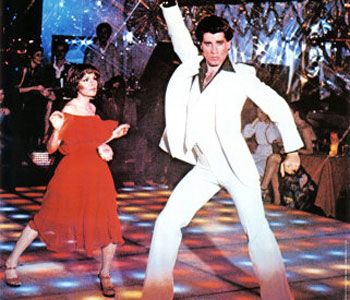
I listened to "Love to Love you Baby" and it was awkward. I honestly couldn't believe what I was hearing. How could the electronic/synthesized sounds combined with "moans" appeal to people? This definitely was not what I had anticipated to hear. So I switched over to "Good Times" by Chic and this was more along the idea of what I was thinking. I question whether Bruno Mars "borrowed" some of the instrumental riffs from this song and used it in "Uptown Funk." The lyrics were pretty simple with a constant bass/synthesizer keeping the beat.
As we start getting into music that is "different" I'm sad that there were no Bob Marley selections. While there was a large portion to read about his impact on music and how he really brought the reggae sound to America, there was no opportunity for listening to his style. The book mentioned his album Legend and how it continues to make money today, well after Marley's death. That album brings back a lot of good memories of summer-time as a kid. Although it wasn't an option, I went ahead and listened to some of those classics:
I then listened to something unfamiliar, "Poncho and Lefty" by Townes Van Zandt. This reminds me of "Ghostriders in the Sky." It tells a story, like the older country songs did. One thing I wasn't a fan of was the very twangy voice. Changing gears, I listened to "Psycho Killer" and was surprised by what I heard. You could tell that the band were minimalists. They used as little instruments as they needed to. There were some weird talk-singing going on throughout as well as random French thrown in. I'm not exactly sure I "got it." I wish there would have been more punk selections because it's a genre I'm really unfamiliar with. I read up on the Sex Pistols and would have loved an analysis of this song:
In conclusion, I listened to "The Message." Hip-Hop is another genre that I'm only starting to learn about and I find the history of hip-hop fascinating. So many people think that hip-hop and rap started with people talking about how women wronged them and that life is all about sex, drugs, and money, but it isn't. I like the funky beat and thought the song was really trying to make society aware of what life was like in the ghetto - every person had their own story of what was going on, in the end if you stay in the ghetto you'll go crazy.
Sunday, November 22, 2015
Module 5
This week's listening started out with the Supreme's 1966 song "You Can't Hurry Love." This is probably going to sound sacrilegious, but I'm not a big fan of Motown music (and I'm from metro-Detroit). The song, however, was quite catchy with the tambourine. I found that the lyrics might have been a little too serious for the tempo and overall feel of the song. To me the lyrics were really telling the listener that love is patient. I definitely wouldn't associate patience with a quick-tempoed song.
The three Beatles songs were very interesting. I'd consider myself a very "surface-level" Beatles fan - I listen to them and enjoy their music, but don't know much about their musical history and how their style evolved. Listening to "Please Please Me," I found the song to be very simple in regards to text and the instruments. It was also very short. The tempo and lyrics were clearly an indication of why the song was so popular. In "A Hard Day's Night," I found that the lyrics were a little more deeper. In the B section, there were higher vocals. The Beatles also really seemed to emphasize the words "home" and "right." It was also interesting to find out that this was the title song to a movie. I love the song "Yesterday." The slow ballad with heartbreaking lyrics really connect with anyone who has ever gone through a breakup. This was also the first time we hear the Beatles using a string ensemble as the song picks up. Finally, I listened to "Elenor Rigby.: This is one of those songs that I had heard before, but never really payed attention to the lyrics. The lyrics are actually quite depressing. It really makes you think about loneliness, especially when Elenor Rigby and the Father never interact before Elenor passes away. I love that the Beatles chose to use the string family in this song. I think it adds a bit of mystery and also sadness. After listening to all of these Beatles songs and then reading about their psychedelic album, I stumbled upon the Rolling Stones' response album Satanic Majesties Request and found this weird video for "2000 Light Years From Home." The introduction reminded me of something by Philip Glass, very interesting. I included the video below:
I found "Good Vibrations" very enjoyable. The Beach Boys definitely had a much different sound than the Beatles. I look at the Beach Boys and compare them to the Beatles' cool surfing cousins from California (perhaps it's because of "Surfin' USA). The verses were very different sounding than the chorus in this song. I found the verses to be very eerie. At one point, I thought I heard a theremin in the chorus.
Sam Cooke is not an artist that I'm very familiar with. The fact that he started "A Change is Gonna Come" with an orchestra made me assume that the song was going to be a love song. It definitely wasn't. The lyrics were actually very serious. I think that's what I enjoyed most about the song, he used the music to address something that everyone goes through; picking yourself back up even when you fall down.
James Brown is an interesting man. His music is very different than those of Ray Charles and Sam Cooke. In "Papa's Got a Brand New Bag" his lyrics seemed like nonsense to me. I wasn't sure if they were trying to tell a story and if they were I had no idea what that story was. He had a big instrument section - brass, guitar, drums, bass, etc. Brown's voice is very unique and after watching some youtube videos he is very energetic and engaging with the audience.
I love folk music and I wish we could spend more time on the folk music of the 60s. Bob Dylan is definitely the person you think of when you think about 60s folk music. His song, "Like a Rolling Stone" was interesting. I personally don't like the tone of Dylan's voice, but I think the message that he's singing about is important. Even now, in 2015, young adults struggle with that transition from childhood to being an adult - like Dylan discusses in "Like a Rolling Stone."
I concluded this week with Cream's cover of Robert Johnson's "Crossroads." I'm sorry I did. I tried to keep an open mind because I find Johnson's song to be such an influence on musicians, but I think Cream ruined it. They turned the iconic blues song to some up-beat, rocking, joke. "Crossroads" is a serious song and should be performed that way. Even the Rolling Stones' cover of the song was respectful! I guess I was just hoping for more.
Timeline
The three Beatles songs were very interesting. I'd consider myself a very "surface-level" Beatles fan - I listen to them and enjoy their music, but don't know much about their musical history and how their style evolved. Listening to "Please Please Me," I found the song to be very simple in regards to text and the instruments. It was also very short. The tempo and lyrics were clearly an indication of why the song was so popular. In "A Hard Day's Night," I found that the lyrics were a little more deeper. In the B section, there were higher vocals. The Beatles also really seemed to emphasize the words "home" and "right." It was also interesting to find out that this was the title song to a movie. I love the song "Yesterday." The slow ballad with heartbreaking lyrics really connect with anyone who has ever gone through a breakup. This was also the first time we hear the Beatles using a string ensemble as the song picks up. Finally, I listened to "Elenor Rigby.: This is one of those songs that I had heard before, but never really payed attention to the lyrics. The lyrics are actually quite depressing. It really makes you think about loneliness, especially when Elenor Rigby and the Father never interact before Elenor passes away. I love that the Beatles chose to use the string family in this song. I think it adds a bit of mystery and also sadness. After listening to all of these Beatles songs and then reading about their psychedelic album, I stumbled upon the Rolling Stones' response album Satanic Majesties Request and found this weird video for "2000 Light Years From Home." The introduction reminded me of something by Philip Glass, very interesting. I included the video below:
I found "Good Vibrations" very enjoyable. The Beach Boys definitely had a much different sound than the Beatles. I look at the Beach Boys and compare them to the Beatles' cool surfing cousins from California (perhaps it's because of "Surfin' USA). The verses were very different sounding than the chorus in this song. I found the verses to be very eerie. At one point, I thought I heard a theremin in the chorus.
Sam Cooke is not an artist that I'm very familiar with. The fact that he started "A Change is Gonna Come" with an orchestra made me assume that the song was going to be a love song. It definitely wasn't. The lyrics were actually very serious. I think that's what I enjoyed most about the song, he used the music to address something that everyone goes through; picking yourself back up even when you fall down.
James Brown is an interesting man. His music is very different than those of Ray Charles and Sam Cooke. In "Papa's Got a Brand New Bag" his lyrics seemed like nonsense to me. I wasn't sure if they were trying to tell a story and if they were I had no idea what that story was. He had a big instrument section - brass, guitar, drums, bass, etc. Brown's voice is very unique and after watching some youtube videos he is very energetic and engaging with the audience.
I love folk music and I wish we could spend more time on the folk music of the 60s. Bob Dylan is definitely the person you think of when you think about 60s folk music. His song, "Like a Rolling Stone" was interesting. I personally don't like the tone of Dylan's voice, but I think the message that he's singing about is important. Even now, in 2015, young adults struggle with that transition from childhood to being an adult - like Dylan discusses in "Like a Rolling Stone."
I concluded this week with Cream's cover of Robert Johnson's "Crossroads." I'm sorry I did. I tried to keep an open mind because I find Johnson's song to be such an influence on musicians, but I think Cream ruined it. They turned the iconic blues song to some up-beat, rocking, joke. "Crossroads" is a serious song and should be performed that way. Even the Rolling Stones' cover of the song was respectful! I guess I was just hoping for more.
Timeline
Monday, November 9, 2015
Module 4
It was really hard for me to not spend all of my time listening to music that I was familiar and comfortable with during this week's listening assignment. I started off with two of my favorite singers, Frank Sinatra and Nat King Cole. "Nancy" is not a song that I am too familiar with. I had heard it before, but I'm used to listening to Sinatra's older material. The first thing I noticed was how young he sounded (remember, this is in comparison to what I'm used to listening to). I really enjoyed the orchestra. I felt the strings gave the song a very romantic feel, which complimented the lyrics. Something that Sinatra did that I really enjoyed was his use of rubato. One place where it really stood out was when he sang "keep... Betty Gable." Nat King Cole has a very different sound than Frank Sinatra. In some ways, I prefer it to Sinatra's - depending on the mood of the song. The first time I had heard "Nature Boy" was actually a cover by David Bowie. It was definitely a treat to hear Cole's version. I was surprised to hear that the orchestral introduction didn't really give the listener any clues as to what the melody would sound like. In fact, when the vocal line came in it seemed very separate from the orchestra. There were a couple of times when I thought the orchestra was adding sound effects (ex. the flute sounded like a bird). When the piano took over, I thought the embellishments really fit and kept the song interesting. I'm including the David Bowie version of this song just to show how different a voice can affect the same song.
As I listened to "Choo Choo Ch'Boogie" I kept asking myself what genre of music I was listening to. Honestly, I still don't know. Part of me wants to say the blues, but I know that's not right because the tempo was very fast and the lyrics didn't allude to anything upsetting or depressing. The first thing I heard was the horn section blowing away; I'm assuming this was to imitate the sound of a train blowing. Aside from the very fast vocal lines I also noticed the saxophone solo. I felt that this could be characteristic of jazz music.
I switched over to the blues and listened to "Hoochie Coochie Man" by the famous Muddy Waters. Sadly, before teaching this history of rock and popular music class I had never really heard of Muddy Waters. He was a very talented musician and is the leading figure when we think of the Chicago blues style. The instrumental pattern that is played before every phrase in the verses of "Hoochie Coochie Man" is really my idea of what the blues sounds like. Muddy Waters and his bandmates' style of playing and singing is very rough. You don't really hear smooth vocal lines like you did when listening to the standards of Sinatra and Nat King Cole. Similarly, Big Mama Thornton's version of "Hound Dog" was quite different from Elvis' version. Right away, I noticed her big and powerful voice. The introduction reminded me of a recitative in an operatic aria. Unlike Elvis' version, I found this original to have smoother instruments. It was less rock-and-roll.
I respect Hank Williams as a musician, but I am not a fan of early country and western music. Hank Williams does a lot of vocal scooping in "I'm So Lonesome I Could Cry." As with most early country singers, he definitely has that twang, but one thing that really stood out for me was his wide vowels. The accompaniment was fairly simple. I believe someone was playing the steel guitar during an instrumental interlude.
We finally start to get into rock-and-roll. The song "Maybellene" by Chuck Berry wasn't a favorite of mine. I noticed that there were quite a few instruments, tambourine, electric guitar, drum set, and bass. Aside from the chorus, Chuck Berry pretty much talk-sang throughout the verses. Little Richard's song "Long Tall Sally" was one of those songs that made you want to tap your foot. I don't know if I'd consider this a rock-and-roll song. To me, this was more of an R&B song. Little Richard has a very unique and higher pitched voice. He definitely used that to his advantage by adding a lot of vocal melismas and effects. "Charlie Brown" is a song that I could definitely see kids relating to. It's interesting to hear the change in music/lyrics as time progresses. We're starting to see musicians tailoring their music to reach the younger consumers. This is a perfect example of that. The bass voice that's used for "Why's everybody always picking on me?" and the high pitched voices in the middle are definitely added in there for the kids and teenagers. The song is in a very simple AABA structure and features many instruments that have been mentioned previously.
As I'm currently wrapping up my Elvis lecture with my students, it was interesting to hear "Don't Be Cruel" as one of the listening examples for this week. This was obviously one of his first hits, so the singing a very nice and easy - he's not really going for it. I felt that this was a combination of country and early rock styles. I'm including a video performance of this song because Elvis seems so shy in the video. You'll notice that he's not really engaging with the audience or camera and this was obviously before he started his fancy dance moves!
I switched over to the blues and listened to "Hoochie Coochie Man" by the famous Muddy Waters. Sadly, before teaching this history of rock and popular music class I had never really heard of Muddy Waters. He was a very talented musician and is the leading figure when we think of the Chicago blues style. The instrumental pattern that is played before every phrase in the verses of "Hoochie Coochie Man" is really my idea of what the blues sounds like. Muddy Waters and his bandmates' style of playing and singing is very rough. You don't really hear smooth vocal lines like you did when listening to the standards of Sinatra and Nat King Cole. Similarly, Big Mama Thornton's version of "Hound Dog" was quite different from Elvis' version. Right away, I noticed her big and powerful voice. The introduction reminded me of a recitative in an operatic aria. Unlike Elvis' version, I found this original to have smoother instruments. It was less rock-and-roll.
I respect Hank Williams as a musician, but I am not a fan of early country and western music. Hank Williams does a lot of vocal scooping in "I'm So Lonesome I Could Cry." As with most early country singers, he definitely has that twang, but one thing that really stood out for me was his wide vowels. The accompaniment was fairly simple. I believe someone was playing the steel guitar during an instrumental interlude.
We finally start to get into rock-and-roll. The song "Maybellene" by Chuck Berry wasn't a favorite of mine. I noticed that there were quite a few instruments, tambourine, electric guitar, drum set, and bass. Aside from the chorus, Chuck Berry pretty much talk-sang throughout the verses. Little Richard's song "Long Tall Sally" was one of those songs that made you want to tap your foot. I don't know if I'd consider this a rock-and-roll song. To me, this was more of an R&B song. Little Richard has a very unique and higher pitched voice. He definitely used that to his advantage by adding a lot of vocal melismas and effects. "Charlie Brown" is a song that I could definitely see kids relating to. It's interesting to hear the change in music/lyrics as time progresses. We're starting to see musicians tailoring their music to reach the younger consumers. This is a perfect example of that. The bass voice that's used for "Why's everybody always picking on me?" and the high pitched voices in the middle are definitely added in there for the kids and teenagers. The song is in a very simple AABA structure and features many instruments that have been mentioned previously.
As I'm currently wrapping up my Elvis lecture with my students, it was interesting to hear "Don't Be Cruel" as one of the listening examples for this week. This was obviously one of his first hits, so the singing a very nice and easy - he's not really going for it. I felt that this was a combination of country and early rock styles. I'm including a video performance of this song because Elvis seems so shy in the video. You'll notice that he's not really engaging with the audience or camera and this was obviously before he started his fancy dance moves!
Monday, November 2, 2015
Module 3
This week's listening has officially caught me up with where I am with my students taking my history of rock and roll class. Starting out with the blues, I listened to "St. Louis Blues" first. I was surprised because I was assuming the song would follow the standard AAB format, but after the first verse it changed. Bessie Smith's voice is so powerful and belty! It still surprises me that she's able to sing over a band. I noticed that in this song, the voice and trumpet are using call-and-response (where Smith sings a phrase and the trumpet responds). Sticking with the blues, I decided to listen to "Black Snake Moan" because I wasn't familiar with that song. This was definitely the delta style blues that I was anticipating - acoustic guitar, solo voice, AAB text. Like many blues songs, this also had a call-and-response feel, with the guitar responding after every verse. Blind Lemon was obviously an untrained singer; his voice was very rough sounding.
Check out this video of Bessie Smith in her only movie appearance. The film was titled St. Louis Blues and here she is singing the song:
I consider gospel to be religious counterpart of the blues. I listened to "The Sun Didn't Shine" and really enjoyed what I heard. There was a solo voice that sang the verse while the other singers hummed in the background. All the voices came together and sang during the verse in a chordal style. I was surprised that I didn't hear a lot of melismas in the solo singing because that is something that I associate with gospel music.
"Wrappin it Up" and "Taking a Chance on Love" were my ideas of early jazz music. In "Wrappin it Up" I heard a lot of instruments playing different parts. It seemed like they were playing in a very chordal style. I did notice that one instrument soloing was characteristic of jazz, however I don't think it was improvising. In "Taking a Chance on Love" there was a lot of call-and-response in the instruments. When the voice came it, the singer had a very pleasant tone. The song seemed very "singable," meaning it wasn't to challenging.
The swing era isn't my favorite. I find all of the music to sound relatively the same (same tempo, instruments, etc.). However, when I think of swing music, I think of "In the Mood." In this piece, there's a lot of back and forth between the brass and saxophone. Is there vocal swing music? I suppose if there were, "Paper Doll" would fall into that category. "Paper Doll" had a solo male voice singing while other male voices sang "oo" in the background. There was also a guitar playing softly with the background singers. During the middle, perhaps the refrain, the tempo picked up. I also noticed that around 1:40, all the singers were together and singing chords.
My last three elective pieces were very different. I first listened to "Caravan." Although this was a jazz piece, it had some characteristics of Latin American rhythms in the melody. I particularly enjoyed the drum introduction. While listening, I wondered if the other instruments were performing some sound effects. There were times when the piano or a horn would make a random sound that didn't seem to fit in with the rest of the music. I did a little research and saw that "Caravan" was actually featured in the movie Whiplash. I've only seen the movie once so I didn't remember hearing it.
I thought that "Nague" was very exciting. I'm not very familiar with the Latin American influence on American music so I wanted to listen to one of those selections. I was pretty startled by the loud trumpets in the beginning. There was also a lot of syncopation. The voice repeated every phrase and I wondered if that was intentional. If so, what was the point? Finally, I listened to "New San Antonio Rose." I'll be honest, when I first started listening to the song, I wasn't sure what the genre was. The beginning instruments sounded like Latin American instruments, specifically in the trumpets. Once the voice came in, I thought it was more typical of country and twang.
Prea Saunders Timeline
Check out this video of Bessie Smith in her only movie appearance. The film was titled St. Louis Blues and here she is singing the song:
I consider gospel to be religious counterpart of the blues. I listened to "The Sun Didn't Shine" and really enjoyed what I heard. There was a solo voice that sang the verse while the other singers hummed in the background. All the voices came together and sang during the verse in a chordal style. I was surprised that I didn't hear a lot of melismas in the solo singing because that is something that I associate with gospel music.
"Wrappin it Up" and "Taking a Chance on Love" were my ideas of early jazz music. In "Wrappin it Up" I heard a lot of instruments playing different parts. It seemed like they were playing in a very chordal style. I did notice that one instrument soloing was characteristic of jazz, however I don't think it was improvising. In "Taking a Chance on Love" there was a lot of call-and-response in the instruments. When the voice came it, the singer had a very pleasant tone. The song seemed very "singable," meaning it wasn't to challenging.
The swing era isn't my favorite. I find all of the music to sound relatively the same (same tempo, instruments, etc.). However, when I think of swing music, I think of "In the Mood." In this piece, there's a lot of back and forth between the brass and saxophone. Is there vocal swing music? I suppose if there were, "Paper Doll" would fall into that category. "Paper Doll" had a solo male voice singing while other male voices sang "oo" in the background. There was also a guitar playing softly with the background singers. During the middle, perhaps the refrain, the tempo picked up. I also noticed that around 1:40, all the singers were together and singing chords.
My last three elective pieces were very different. I first listened to "Caravan." Although this was a jazz piece, it had some characteristics of Latin American rhythms in the melody. I particularly enjoyed the drum introduction. While listening, I wondered if the other instruments were performing some sound effects. There were times when the piano or a horn would make a random sound that didn't seem to fit in with the rest of the music. I did a little research and saw that "Caravan" was actually featured in the movie Whiplash. I've only seen the movie once so I didn't remember hearing it.
I thought that "Nague" was very exciting. I'm not very familiar with the Latin American influence on American music so I wanted to listen to one of those selections. I was pretty startled by the loud trumpets in the beginning. There was also a lot of syncopation. The voice repeated every phrase and I wondered if that was intentional. If so, what was the point? Finally, I listened to "New San Antonio Rose." I'll be honest, when I first started listening to the song, I wasn't sure what the genre was. The beginning instruments sounded like Latin American instruments, specifically in the trumpets. Once the voice came in, I thought it was more typical of country and twang.
Prea Saunders Timeline
Sunday, November 1, 2015
Module 2
I was really excited to see some of the listening activities for this week because some of them were familiar tunes to me.
Beginning with the rags, I found the "Castle House Rag" to be very characteristic of piano rags. There were steady bass chords with an exciting and syncopated melody. Listening to this rag reminded me of the show Boardwalk Empire because this music was very characteristic of that time period. In addition to the "Castle House Rag" I found that the "Tiger Rag" and "Dipper Mouth Blues" were quite similar in style. These two pieces were played by bands. I noticed that both bands were very brass heavy and included a clarinet that seemed to be getting the spotlight most of the time. One thing I found interesting was the sound of a bass drum in the "Tiger Rag." I'm assuming there was a drum kit in there because I thought I heard some cymbals and possibly a snare drum, but it was mainly the bass drum representing the rhythm section. In "Dipper Mouth Blues" I heard a strange tapping sound and due to the poor quality of the recording I couldn't tell what instrument that was.
In "East St. Louis Toodle-oo" I heard that "wah-wah" sound from the trumpet. It made me think of the musical Chicago. I think I also heard a tuba in the band, but obviously the trumpet was the main feature in this piece. This, to me, was the first real jazz selection that I had listened to yet.
"My Blue Heaven" had an interesting introduction with a piano and a cello. When the voice came in, I was very focused on the singer and the lyrics, so I lost focus of whether the cello was still playing. One thing I really enjoyed was the cello playing the melody in an instrumental interlude while the voice did some scat-singing in the background with the cello.
The two versions of "April Showers" were tough to get into. I find Al Jolson's voice not very pleasant to listen to. In both recordings his wide vibrato drove me crazy, to the point of trying to figure out which two pitches he was hovering around! I wasn't a fan of Jolson's over-the-top singing toward the end of the song in the 1932 version.
Finally, we started to get into the songs I'd recognized. I'll be the first to say that I love Bing Crosby and find his voice to be smooth like butter! However, I personally don't think this song was right for him. Perhaps I'm biased because I've only ever listened to Ella Fitzgerald sing this song, but I thought Bing didn't really put the emotion into this song. Taking some time to really listen to the lyrics, you start to realize that Berlin was saying, "My love is greater than any distance imaginable." I found the tempo of Crosby's version to be slightly too fast. He also didn't take the time to really rubato some of those important phrases (ex. "And if I ever lost you, how much would I cry?"). I'm including the Ella Fitzgerald version in this post just to help prove my point.
I love the Gershwin brothers! I strongly believe they they composed some of the best American music. While the textbook mentions Berlin as being one of the most prolific American composers, I think George and Ira Gershwin are right there with him. I know Ethel Merman is a big deal for that time, but I can't stand her voice. Given the choice to listen to her or Jolson sing, I think I might choose Jolson. Ethel Merman is the stereotypical voice that people think of when they think of Broadway (which is sad because Broadway has evolved so much). I've heard many people sing "I Got Rhythm," so it wasn't something new to me. One thing I forgot is the part before the main refrain comes in. I would call it an introduction, but I think the book calls it a verse. I didn't get a sense of musicality from Merman, she didn't seem to put any emotion into her singing. It pretty much sounded like she was just shouting the entire time. I would have preferred to have heard some dynamics and tempo changes.
Beginning with the rags, I found the "Castle House Rag" to be very characteristic of piano rags. There were steady bass chords with an exciting and syncopated melody. Listening to this rag reminded me of the show Boardwalk Empire because this music was very characteristic of that time period. In addition to the "Castle House Rag" I found that the "Tiger Rag" and "Dipper Mouth Blues" were quite similar in style. These two pieces were played by bands. I noticed that both bands were very brass heavy and included a clarinet that seemed to be getting the spotlight most of the time. One thing I found interesting was the sound of a bass drum in the "Tiger Rag." I'm assuming there was a drum kit in there because I thought I heard some cymbals and possibly a snare drum, but it was mainly the bass drum representing the rhythm section. In "Dipper Mouth Blues" I heard a strange tapping sound and due to the poor quality of the recording I couldn't tell what instrument that was.
In "East St. Louis Toodle-oo" I heard that "wah-wah" sound from the trumpet. It made me think of the musical Chicago. I think I also heard a tuba in the band, but obviously the trumpet was the main feature in this piece. This, to me, was the first real jazz selection that I had listened to yet.
"My Blue Heaven" had an interesting introduction with a piano and a cello. When the voice came in, I was very focused on the singer and the lyrics, so I lost focus of whether the cello was still playing. One thing I really enjoyed was the cello playing the melody in an instrumental interlude while the voice did some scat-singing in the background with the cello.
The two versions of "April Showers" were tough to get into. I find Al Jolson's voice not very pleasant to listen to. In both recordings his wide vibrato drove me crazy, to the point of trying to figure out which two pitches he was hovering around! I wasn't a fan of Jolson's over-the-top singing toward the end of the song in the 1932 version.
Finally, we started to get into the songs I'd recognized. I'll be the first to say that I love Bing Crosby and find his voice to be smooth like butter! However, I personally don't think this song was right for him. Perhaps I'm biased because I've only ever listened to Ella Fitzgerald sing this song, but I thought Bing didn't really put the emotion into this song. Taking some time to really listen to the lyrics, you start to realize that Berlin was saying, "My love is greater than any distance imaginable." I found the tempo of Crosby's version to be slightly too fast. He also didn't take the time to really rubato some of those important phrases (ex. "And if I ever lost you, how much would I cry?"). I'm including the Ella Fitzgerald version in this post just to help prove my point.
I love the Gershwin brothers! I strongly believe they they composed some of the best American music. While the textbook mentions Berlin as being one of the most prolific American composers, I think George and Ira Gershwin are right there with him. I know Ethel Merman is a big deal for that time, but I can't stand her voice. Given the choice to listen to her or Jolson sing, I think I might choose Jolson. Ethel Merman is the stereotypical voice that people think of when they think of Broadway (which is sad because Broadway has evolved so much). I've heard many people sing "I Got Rhythm," so it wasn't something new to me. One thing I forgot is the part before the main refrain comes in. I would call it an introduction, but I think the book calls it a verse. I didn't get a sense of musicality from Merman, she didn't seem to put any emotion into her singing. It pretty much sounded like she was just shouting the entire time. I would have preferred to have heard some dynamics and tempo changes.
Sunday, October 25, 2015
Module 1
The old-time music selections provided a look into the origins of British ballad tradition and the string band tradition. I noticed that in all three selections, the vocals (if there were any) were very simple melodies. I didn't hear any vocal embellishments or deviations from the melody. In "Barbary Ann," every verse sounded the same. The two versions of "Soldier's Joy" really allowed me to hear the fast and technical playing style. I personally preferred Tommy Jarrell's version because I felt his solo version allowed him a little more freedom.
"Coo Coo," "Long John," and "Stagolee" were all examples of early African American music. I found that "Coo Coo" was difficult to understand the lyrics, but the form reminded me of early blues music. There was an acoustic guitar and solo singer. The singer would sing a short verse then play a response with his guitar. Similarly, in "Long John" the call and response format is followed, but with singers. The leader would sing a line and everyone would echo him. This work song was probably my favorite of all of the listening selections from early African Americans. I found that while "Stagolee" was more melodic than the other two songs, I had a difficult time staying focused and enjoying what I was hearing.
The two versions of "La Comparsita" were very different from one another. My preference was on the Gardel recording. I loved the operatic singing with minimal instrumentation. The guitars were there to support the singer, but obviously the singer was the main attraction of the song. I noticed in the Canaro version, many instruments were added. I thought this arrangement was okay, but felt there was just too much going on. There were too many instruments and it sounded like they were all fighting for attention.
In "Enigue Nigue," I found myself confused. I honestly didn't know what was happening. It seemed like all the musicians were "marching to the beat of their own drum." By that, I mean that the rhythmic patterns didn't seem to fit. Perhaps I had found a really poor version of the song, but I just couldn't figure out how everything worked together. Then suddenly, people just started singing over the crazy percussion parts. "La Negra" was completely different. This was exactly how I thought a mariachi band should sound like. There were many instruments that we haven't really heard played together in these chapters (until now), like the trumpets with the singers, guitar, and violins. I felt that the instruments and the singers had a good balance of call and response.
Last, were the first real popular songs in America. Stephen Foster's composition "Jeanie with the Light Brown Hair" is not my favorite. However, he follows his traditional style where the accompanying instrument plays the melody first then the voice comes in with minimal accompaniment. This makes sense because parlor songs were composed with the idea of an amature musician being able to play and sing for people. I had never heard "After the Ball" before and was surprised to see that it was composed around the same time as Stephen Foster's compositions. I felt that this was the first time we're starting to hear hints of the American Musical Theatre genre. The music is fairly simple and telling a story, but I noticed that every time the singer got to the chorus, it was sung just a little differently. I also noticed that each section (A, B, and C) were drastically different in sound, plus the addition of a speaking part was interesting.
Hearing one of Stephen Foster's compositions this week inspired me to listen to my favorite Foster composition, "Beautiful Dreamer."
"Coo Coo," "Long John," and "Stagolee" were all examples of early African American music. I found that "Coo Coo" was difficult to understand the lyrics, but the form reminded me of early blues music. There was an acoustic guitar and solo singer. The singer would sing a short verse then play a response with his guitar. Similarly, in "Long John" the call and response format is followed, but with singers. The leader would sing a line and everyone would echo him. This work song was probably my favorite of all of the listening selections from early African Americans. I found that while "Stagolee" was more melodic than the other two songs, I had a difficult time staying focused and enjoying what I was hearing.
The two versions of "La Comparsita" were very different from one another. My preference was on the Gardel recording. I loved the operatic singing with minimal instrumentation. The guitars were there to support the singer, but obviously the singer was the main attraction of the song. I noticed in the Canaro version, many instruments were added. I thought this arrangement was okay, but felt there was just too much going on. There were too many instruments and it sounded like they were all fighting for attention.
In "Enigue Nigue," I found myself confused. I honestly didn't know what was happening. It seemed like all the musicians were "marching to the beat of their own drum." By that, I mean that the rhythmic patterns didn't seem to fit. Perhaps I had found a really poor version of the song, but I just couldn't figure out how everything worked together. Then suddenly, people just started singing over the crazy percussion parts. "La Negra" was completely different. This was exactly how I thought a mariachi band should sound like. There were many instruments that we haven't really heard played together in these chapters (until now), like the trumpets with the singers, guitar, and violins. I felt that the instruments and the singers had a good balance of call and response.
Last, were the first real popular songs in America. Stephen Foster's composition "Jeanie with the Light Brown Hair" is not my favorite. However, he follows his traditional style where the accompanying instrument plays the melody first then the voice comes in with minimal accompaniment. This makes sense because parlor songs were composed with the idea of an amature musician being able to play and sing for people. I had never heard "After the Ball" before and was surprised to see that it was composed around the same time as Stephen Foster's compositions. I felt that this was the first time we're starting to hear hints of the American Musical Theatre genre. The music is fairly simple and telling a story, but I noticed that every time the singer got to the chorus, it was sung just a little differently. I also noticed that each section (A, B, and C) were drastically different in sound, plus the addition of a speaking part was interesting.
Hearing one of Stephen Foster's compositions this week inspired me to listen to my favorite Foster composition, "Beautiful Dreamer."
Subscribe to:
Posts (Atom)